
Home / About Pheochromocytoma
About Pheochromocytoma
What it is, where it forms, why it’s rare, and how genetics can play a role.
What is pheochromocytoma?
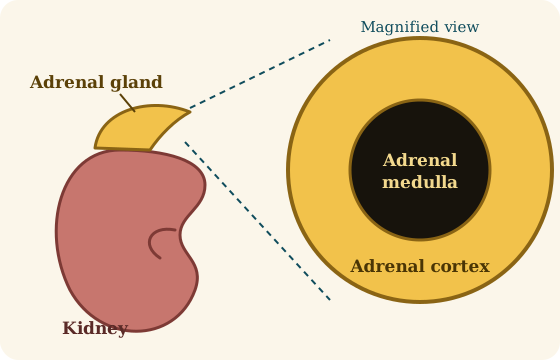
Pheochromocytoma is a rare tumor that forms in the adrenal medulla, the center of an adrenal gland[1]. It grows from chromaffin cells, cells that make hormones the body needs[2]. Usually it affects one adrenal gland, but it can affect both, and sometimes there is more than one tumor in one gland[1].
Most pheochromocytomas are benign, meaning they are not cancer[2],[3]. Even so, they can cause serious health problems because of the hormones they release, so they need to be found and treated.
The adrenal glands & catecholamines
You have two adrenal glands, one on top of each kidney in the back of the upper abdomen. Each has an outer layer (the adrenal cortex) and a center (the adrenal medulla)[1].
The adrenal glands make hormones called catecholamines. Adrenaline (epinephrine) and noradrenaline (norepinephrine) help control heart rate, blood pressure, blood sugar, and the way the body reacts to stress[1]. The Pheo Para Alliance notes that dopamine is also a catecholamine[8].
A pheochromocytoma can release extra adrenaline and noradrenaline into the blood. That excess can cause high blood pressure, headaches, sweating, a pounding heartbeat, and other symptoms[1],[8].
Pheochromocytoma and paraganglioma
Paragangliomas are closely related tumors that form outside the adrenal gland — for example near the carotid artery, along nerve pathways in the head and neck, and in other parts of the body[1]. Under the microscope, pheochromocytoma and paraganglioma look the same; they are named differently mostly by where they are found[3].
- About 80–85% of these tumors occur in the adrenal medulla; about 15–20% occur elsewhere, such as the chest, abdomen, pelvis, bladder, or neck and skull base[2],[3].
- Some paragangliomas (often in the head and neck) are “silent,” meaning they do not make extra hormones[3].
- Together, they are often called “pheo para” or PPGL.
How rare is it?
Nobody knows exactly. Many people are never diagnosed, so the true number is unknown[2]. One estimate suggests about 8 people per 1 million, but the NCI notes that this estimate may be low[2]. NORD describes these tumors as occurring in less than 1 percent of people with high blood pressure[3].
They can occur at any age and affect men and women equally[3],[8]. They are most common between ages 30 and 50[2],[3], and about 10% of cases are thought to occur in children[3].
Benign vs. cancerous: estimates differ
Sources give somewhat different numbers for how often these tumors spread: the NCI says only about 10% do[2], NORD says about 85% are non-cancerous[3], and the Pheo Para Alliance says about 15–25% can become metastatic[8]. What sources agree on is that most are benign — and that every person’s situation is different.
Genetics & hereditary syndromes
Most cases happen for unknown reasons (“sporadic”), but a significant share are inherited. Estimates vary: about one third[7], 25–35%[2], about 35%[3], or 30–40%[8]. Scientists have linked about 20 genes to these tumors[2]. Inherited cases follow an autosomal dominant pattern, meaning each child of an affected parent has a 50% chance of inheriting the gene change[3].
Inherited syndromes and gene changes that raise the risk include[1]:
- Multiple endocrine neoplasia type 2 (MEN2A and MEN2B)
- von Hippel-Lindau (VHL) syndrome
- Neurofibromatosis type 1 (NF1)
- Hereditary paraganglioma-pheochromocytoma syndrome (including SDHx gene changes)
- Hereditary leiomyomatosis and renal cell cancer
- Carney-Stratakis dyad (paraganglioma and gastrointestinal stromal tumor, or GIST)
- Carney triad (paraganglioma, GIST, and pulmonary chondroma)
Genetic counseling
The NCI states that everyone diagnosed with pheochromocytoma or paraganglioma should have genetic counseling to learn their risk of an inherited syndrome and related cancers[1]. When a gene change is found, testing is usually offered to at-risk family members, including those without symptoms[1].
Mini glossary
- Adrenal medulla
- The center of the adrenal gland, where pheochromocytoma forms.
- Catecholamines
- Hormones such as adrenaline and noradrenaline that help control heart rate, blood pressure, and the stress response.
- Metanephrines
- Substances the body makes when it breaks down catecholamines; measured in blood or urine tests.
- Paraganglioma
- A similar tumor that forms outside the adrenal gland.
- Benign / malignant
- Benign tumors are not cancer; malignant tumors are cancer and can spread.
- Sporadic vs. hereditary
- Sporadic tumors happen without a known inherited cause; hereditary tumors are linked to gene changes passed through families.